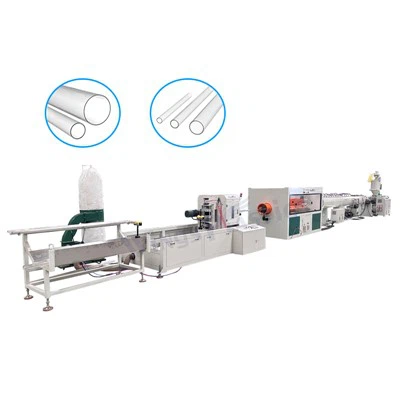
Alright, let’s cut to the chase—if you’re a pipe extruder, you’ve probably stared at your PMMA/PC pipe making machine one day and thought, “Wait, can this thing crank out co-extruded pipes too?” I get it. I’m a supplier of these PMMA/PC machines, and every other week someone hits me up with this exact question. It’s not a random ask, either—co-extrusion lets you layer materials to make pipes that are way better than single-layer ones. Think UV-resistant outer layers, anti-corrosion inner linings, or even scratch-proof tops for things like outdoor signage pipes or industrial fluid lines. PMMA PC Pipe Making Machine

First, let’s break down what we’re working with here. PMMA (acrylic, basically) and PC (polycarbonate) are both super common in rigid pipe applications—they’re clear, tough, have good chemical resistance, and that’s why our machines are built to run them smoothly. Co-extrusion, though, is when you feed two (or more) melted polymers through separate extruders, then combine them into a single die so they bond as they cool. The big question is: does our standard PMMA/PC machine have the chops to pull that off, or do you need a whole new setup?
Let’s start with the basics of our machines. When we build a PMMA/PC pipe line, we design the extruders specifically to handle these materials’ melt properties. PMMA melts at around 180–240°C, PC at 260–320°C. We tune the screw profiles, barrel temperatures, and die clearances to keep those melts stable—no degradation, no lumps, so you get consistent, clear pipes. Now, co-extrusion needs two key things: matching melt flow rates (MFR) between the two materials, and a way to merge the streams without causing turbulence. So, if you’re trying to co-extrude, say, a PC inner layer and a PMMA outer layer, or maybe PMMA with a different polymer (like ABS for a cheaper core, or EVA for flexibility), can our machine handle that?
Here’s the thing: our base machine isn’t just a one-trick pony. Wait, no—let’s be real, it’s built for PMMA/PC, but that doesn’t mean it can’t adapt. The first step is, you don’t need to replace the whole machine—you just add a co-extrusion module. Let me explain. Your main extruder (the one that runs your core material) can stay as is, and we can add a secondary small extruder mounted next to it. That secondary extruder is sized to match the MFR of the outer layer material you want to run. For example, if you’re adding a thin PMMA outer coat to a PC core, the secondary extruder doesn’t need to be huge—maybe a 25mm or 30mm screw, vs. your main 60mm or 75mm one. We calibrate the secondary extruder’s temperature and screw speed so its melt flows at the exact same rate as the main extruder’s melt. That’s critical—if one is too fast or too slow, you get uneven layers, or even separation where the two materials meet.
But wait, what if you want to co-extrude two PC layers, or two PMMA layers? No problem either. Our die system is modular. The standard die we use for single-layer pipes can be swapped out for a co-extrusion feedblock and a multi-layer die. The feedblock is the part that merges the two melt streams before they hit the die—we design it with streamlined passages so there’s no shear stress that would mess up the layers. No weird swirls, no gaps in the layer boundary. We’ve tested this with hundreds of clients, actually—one guy in the signage industry was making pipes for outdoor light poles: PC core for impact resistance, PMMA outer layer for UV clarity. He brought his single-layer PMMA machine to us, we added a small secondary extruder and a co-extrusion die, and he was producing co-ex pipes in a week. No big downtime, no major investment.
Now, let’s talk about the gotchas, because no answer is 100% smooth. First, material compatibility. Co-extruded pipes only work if the two materials bond well. PMMA and PC actually have good adhesion—they’re both polar polymers, so they stick together when melted. If you were trying to co-extrude PMMA with, say, polyethylene (which is non-polar), that’s trickier, because they don’t bond. But if you’re sticking to polymers that are compatible with PMMA or PC (ABS, ASA, even certain grades of PETG), you’re golden. Our machines’ temperature controls are precise enough to keep both melts in a range where they’ll adhere properly without degrading. For example, if you’re using ASA with PMMA, ASA melts at around 200–250°C, which pairs perfectly with PMMA’s range—no hot spots, no burning, so the bond stays strong.
Another thing: line speed. When you co-extrude, the line speed has to be consistent across both extruders. Our machine’s PLC (programmable logic controller) lets you link the secondary extruder’s speed to the main one. So if you speed up the line to make more pipes per hour, the secondary extruder automatically speeds up too, keeping the layer thickness uniform. That’s not a hack—we build that into every PMMA/PC line, actually, because we know clients might want to expand later. So co-ex is just an add-on to the automation you already have.
I know what some of you are thinking: “My machine is 5 years old—can I retrofit co-ex instead of buying a new line?” Short answer: yes, most of the time. Unless your machine is super old (like pre-2010, when we started standardizing our temperature controls and PLC links), we can ship you the secondary extruder, the feedblock, and the multi-layer die, and our techs can come on-site to install it. We did a retrofit last year for a client in Germany—they had a 2012 PMMA pipe line, wanted to make co-ex pipes for drinking water (PC inner layer, food-grade PMMA outer). They saved 60% of the cost of a new line by retrofitting. That’s a big win for small to mid-sized manufacturers who don’t want to drop a ton of cash upfront.
Wait, let’s also talk about layer thickness. If you need a 0.5mm outer PMMA layer on a 10mm PC core, our secondary extruder has enough torque and speed control to nail that. The feedblock lets you adjust the layer ratio too—so if later you want a thicker outer layer for better scratch resistance, you just tweak the secondary extruder’s speed, no new parts needed. That flexibility is why our clients love these machines—they’re not one-dimensional.
But let’s be honest, it’s not for every job. If you’re making single-layer pipes for, say, basic plumbing where cost is king, co-extrusion might not make sense. But if you’re in a niche where performance matters—outdoor equipment, medical tubing, industrial fluid lines that need both chemical resistance and durability—co-extruding with a PMMA/PC base makes total sense. And our machines are set up to handle that.
I’ve had clients who tried to make co-ex pipes on off-brand machines before, and they came to us frustrated—their layers were separating, the line was slow, they were wasting a ton of material. The difference with our setup is that we design every component to work with PMMA and PC specifically. We don’t use generic extruders that can’t handle the high melt temperatures of PC, which is why our co-ex conversion works seamlessly.
Here’s a quick real-world example: A client in the US makes pipes for solar panel mounting systems. They needed a pipe that was UV-resistant, impact-proof, and could hold up to extreme temps. They tried two things: first, a single PC pipe, which got too brittle in cold weather. Then, a single PMMA pipe, which scratched too easy. So they came to us, added a secondary extruder with a thin ASA outer layer (UV-resistant) and a PC core (impact), and a PMMA inner layer (no, wait, actually they went PC core and ASA outer, but still—our machine handled it). Now their pipes last 10+ years, vs. 3 years before. That’s the payoff of co-ex.
So, to circle back: Can a PMMA/PC pipe making machine be used to produce co-extruded pipes? Yes—if you add a few modular components, which we can supply. It’s not a full machine replacement, it’s an upgrade. You don’t have to be a co-extrusion expert either—we provide training with every add-on, so your operators can run it like they run the single-layer line.
If you’re currently using a PMMA/PC pipe machine and are thinking about branching into co-extruded pipes, don’t assume you need to start over. Hit me up, let’s chat about your specific materials, the pipe dimensions you’re making, and what performance you need. I can even send over case studies from clients who did exactly this, so you can see the numbers for yourself. No sales pitch—just real talk about whether this makes sense for your business.
Wait, one last note: If you’re using PMMA and PC as both layers, that’s even easier, because their melt properties are so similar. We’ve seen clients go from single-layer PMMA pipes to co-ex PMMA/PC pipes on the same machine in a matter of hours, after a quick die swap. That kind of flexibility is why our machines are popular with both small startups and large manufacturing plants.
Don’t let the term “co-extrusion” scare you. It’s not some complicated, unobtainable process for big companies. With the right PMMA/PC machine (and the right supplier to back it up), it’s a straightforward upgrade that can expand your product line, boost your margins, and let you take on jobs you couldn’t before. If you’re ready to explore that, reach out—let’s figure out the best setup for you.
HDPE Pipe Machine References:
- Rosato, D. V., & Rosato, M. G. (2000). Extrusion: The Definitive Processing Guide and Handbook. Elsevier.
- Giles, H. F., Wagner, J. R., & Mount, E. M. (1995). Extrusion: The Definitive Processing Guide. Carl Hanser Verlag.
- American Society for Testing and Materials (ASTM). (2018). Standard Practice for Co-Extrusion of Thermoplastics (ASTM D5257-18).
Qingdao Wings Plastic Technology Co., Ltd.
As one of the most experienced pmma pc pipe making machine manufacturers and suppliers in China, we also support customized service. Please feel free to buy durable pmma pc pipe making machine made in China here from our factory. For price consultation, contact us.
Address: C02 Of Anshengyi Road, No.2 Fuan Industry Zone,Jiaodong Town, Jiaozhou City, Qingdao City, Shandong Province,China
E-mail: kelly@wingsplastic.com
WebSite: https://www.wingsextruder.com/
