Hey there, let’s cut through the noise real quick—if you’re dealing with a disc vacuum filter (DVF), you’ve probably googled “filter cake thickness” more times than you can count, right? Me too. As someone who’s been in the DVF game for years—like, I’ve hauled parts to mines at 2 a.m. and troubleshooted caked-on clay cakes so thick they stopped the whole process—this is one of those questions that sounds simple, until it’s not. You think it’s just “set it and forget it”? Nope. Get this wrong, and you’re either wasting wash water (killing your budget) or dumping cake that’s way too wet (screwing up downstream processing). Let’s break this down like we’re chatting over a coffee, no stuffy textbook jargon. Disc Vacuum Filter
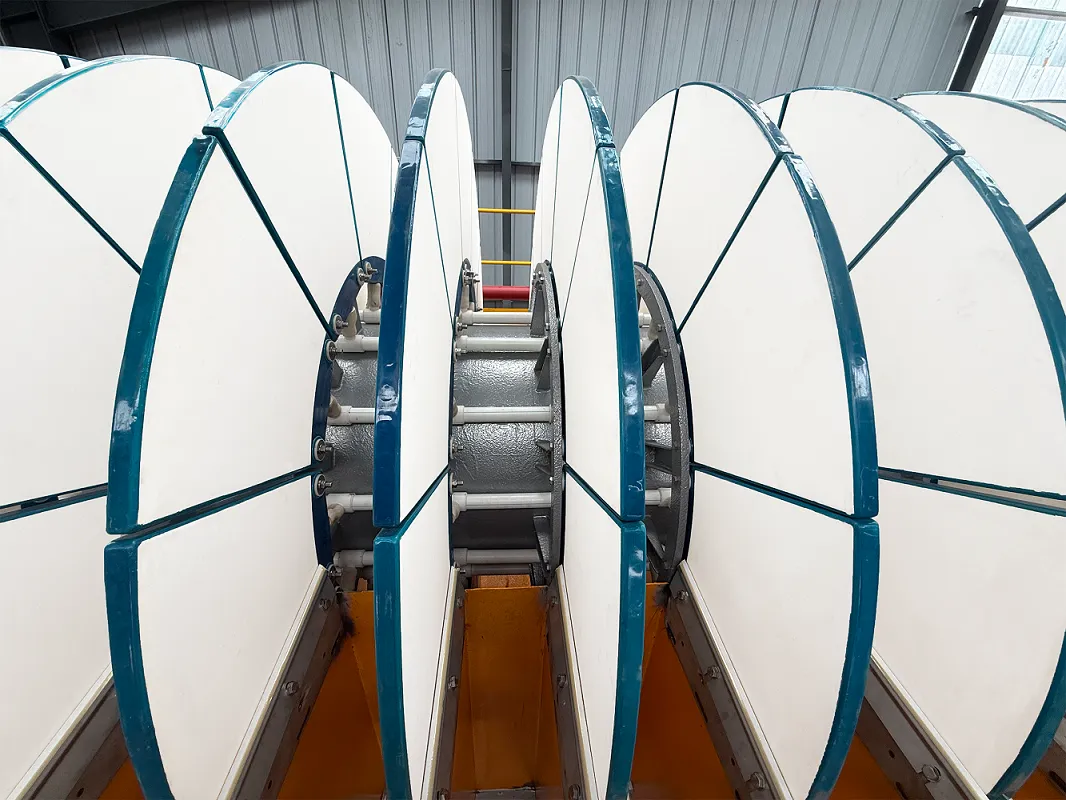
First off, what even is filter cake thickness on a DVF? For anyone who’s new—you know that slop that builds up on the filter cloth as slurry hits the vacuum disc? That’s the cake. Thickness is how deep that layer is, measured from the cloth surface. But here’s the thing: it’s not a one-size-fits-all number. I’ve seen mines run 10 mm cakes like it’s no big deal, and another mine handling fine pharmaceutical powder fighting to keep it under 5 mm. Why? Because your slurry’s makeup, disc speed, vacuum pull—all of that bends the rules.
Let’s start with the heavy hitters: what actually determines this thickness. First, your feed slurry. If you’re filtering coarse stuff—like sand, or iron ore concentrate—those particles are big, they pack loosely, so the cake builds fast. I’ve seen a disc load up with 15 mm of coarse sand in, like, 10 seconds. But if you’re dealing with super fine stuff—like polymer flocculated tailings, or even battery cathode materials that are micron-sized? Those tiny particles clump tight, so they build way slower. One time we had a client working on lithium hydroxide slurry, and their cake took almost a minute to hit 6 mm—total opposite of the sand crew.
Next up: disc rotational speed. This is the number one easy fix for any operator panicking about thickness. The disc spins, right? Each sector spends a certain amount of time submerged in slurry (that’s called “dip time,” by the way—total game changer). If you spin the disc slow, each sector stays in slurry longer, so cake gets thicker. Crank the speed up, dip time drops, cake gets thinner. Simple as that. But wait—don’t go speeding it up just to fix a too-thick cake. If your dip time is too short, the cake might not even fully form before it comes out of the slurry, so you end up with a half-caked mess that won’t discharge right. I’ve had a plant manager yell at me once because he cranked speed up to fix a 12 mm cake, ended up with 2 mm cake that fell off the disc before he could even scrape it off. Oops.
Then there’s vacuum pressure. The suction that pulls water through the cloth to form cake—higher vacuum pulls more water, but does it affect thickness? Kinda. If your vacuum is too low, you get a loose, flaky cake that’s thin, even if dip time is long. Too high, and you might pull slurry particles through the cloth (that’s “blinding,” by the way—big headache) or make the cake so dense that discharge is a nightmare. Most of our clients run between -0.6 bar and -0.8 bar, but like I said, lithium slurry might need -0.7 bar, while sand can get away with -0.5 bar.
Water usage, and wash steps—wait, that’s another big one I almost forgot. If you’re washing the cake while it’s still on the disc, the wash water can erode the top layer, making the final thickness less than what you built. So if you’re running a wash cycle, you might need to build your initial cake a little thicker to compensate. This is huge for mining operations that do counter-current washing—skip this math, and you’re over-washing, wasting 1000s of liters of water a month.
Now, what’s the actual ideal thickness range? Let’s get specific, no vague numbers. For coarse solids (sand, gravel, mineral concentrates >100 microns): 8–15 mm. That sweet spot is thick enough to hold up through discharge, not so thick that it takes forever to form. For medium solids (coal, phosphate rock 20–100 microns): 5–10 mm. Finer stuff (tailings, fine chemicals 5–20 microns): 3–8 mm. Ultra-fine (lithium compounds, pigments <5 microns): 1–5 mm. I’ve even seen a lab-scale DVF for a battery client running at 0.8 mm—yeah, that’s thin, but it’s what they needed to get dry enough for their next process.
But here’s the secret no one tells you: it’s not just about the number. It’s about consistency. Like, if your cake jumps between 2 mm and 10 mm every few minutes, that’s a problem. That’s usually from uneven feed slurry (like if your feed box is sloshing, or the disc is warped—wait, we fix a lot of warped discs that cause that exact issue) or fluctuating vacuum. Consistency matters way more than hitting a perfect 7 mm. I’ve had clients who thought 10 mm was non-negotiable, but once they adjusted their feed to be uniform, they could run 9 mm consistently and cut their cycle time by 15%.
Wait, let’s talk about common mistakes people make, because that’s where I’ve seen most of the pain. First, measuring it wrong. A lot of operators just stick a ruler in the slurry when the disc’s submerged—but that’s the wet cake, which swells. You need to measure it when it’s dry, right before discharge, or use a thickness sensor (we sell high-quality non-contact ones that hook up to your PLC, no more guessing). Second, ignoring flocculants. If you’re not flocculating fine slurry, the cake won’t form properly—so even if you set dip time for 8 mm, you’ll get a lumpy mess that’s uneven. Third, forgetting that disc number and sector coverage play a role. A 12-disc DVF with 40% sector coverage (how much of the disc is submerged) will have different cake thickness than a 6-disc unit with 60% coverage—so you can’t copy another plant’s settings word for word.
What about discharge methods? Oh, that’s another variable. If you’re using a scraper blade to knock the cake off, you can run a little thicker cake—like 12 mm—because the blade will scrape it clean. If you’re using a roll discharge or string discharge (for super delicate cake that can’t be scraped), you need thinner cake, like 3 mm, so it doesn’t tear or leave residue on the cloth. I had a client with a food-grade chemical product that had to use roll discharge—they tried 5 mm cake, and the roll tore it apart, so we adjusted to 2.5 mm, and it worked like a charm.
Let’s get real for a second—why does this matter to you? If you’re running a mining operation, every mm of cake thickness is about $$$. A 1 mm reduction in cake thickness cuts your cycle time by roughly 10%, which means you process more slurry, more product, more revenue. Or if your cake is too thin, you’re using more vacuum than you need, which is extra power cost, and your product might not meet moisture specs. For battery material makers, cake thickness directly affects drying time—too thick, and your kiln has to run longer, wasting energy and time.
Wait, let’s share a quick example of a client we helped last year. A copper mine in Arizona was complaining their DVF was producing 14 mm cake, which was way too wet—their downstream smelter was rejecting it because of high moisture. They were running the disc at 2 RPM, vacuum at -0.8 bar. We did a walkthrough, measured their slurry particle size was 70 microns (medium range), so we suggested bumping disc speed to 2.5 RPM (increased dip time? No, wait—higher speed means less dip time, so thinner cake). We also checked their vacuum, and it was actually dropping to -0.7 bar when the cake formed, so we adjusted the vacuum pump to hold steady at -0.75 bar. Result? Cake thickness dropped to 8 mm, moisture went down 2%, they got accepted by the smelter, and they’re now processing 12% more slurry because the disc cycles faster. That’s the kind of small adjustment that makes a huge difference.
So, what should you do if you’re dealing with this? First, get a baseline: measure your particle size, check your current disc speed and vacuum, note your discharge method. Start small—adjust disc speed by 0.5 RPM increments, test cake thickness, see how it affects your discharge and moisture. If you’re struggling with consistency, check for feed unevenness, cloth blinding, or worn parts (we can help with that). And if you’re using ultra-fine material, look into adding a flocculation step—we’ve seen that fix more cake thickness issues than any other tweak.
Look, I’m not here to sell you something you don’t need. But if you’re tired of guessing your filter cake thickness, or fighting inconsistent cake that’s messing up your process, let’s chat. Whether you’re a small operation troubleshooting a single disc or a big plant looking to upgrade your whole system, we’ve got the gear and the know-how to nail those settings. No sales pitch fluff, just real advice from people who’ve been in your shoes.
At the end of the day, filter cake thickness on a disc vacuum filter isn’t a mystery. It’s all about matching your settings to your specific slurry, process needs, and discharge method. Skip the random google searches that give you generic numbers, and focus on consistency— that’s the real key. Got questions about your specific setup? Reach out, let’s figure it out together.
Ceramic Disc Filter References:
- Svarovsky, L. (2000). Solid-Liquid Separation (4th ed.). Butterworth-Heinemann.
- Wakeman, R. J., & Tarleton, E. S. (1999). Filtration: Equipment Selection, Modelling and Process Simulation. Elsevier.
- Davis, M. E., & Deer, J. G. (2019). Practical Guide to Vacuum Filtration for Mineral Processing. Mining Engineering.
Shandong Zhongyu Industrial Control Technology Co., Ltd.
As one of the most professional disc vacuum filter manufacturers and suppliers in China, we have world-leading production equipment and strong manufacturing capabilities. Please rest assured to buy customized disc vacuum filter at competitive price from our factory.
Address: 1-2408, Building B, Huanqi Building, No.165 Xincun West Road, Mashang Street, Zhangdian District, Zibo City, Shandong Province
E-mail: Dave@sdzygk.com
WebSite: https://www.ceramicdiscfilter-zy.com/
