Hey everyone, thanks for popping in. If you’re here, chances are you’re either deep in the manufacturing game, just stumbled on bimetal stuff because you need parts for a project, or maybe you’re as obsessed with random material properties as I am (no judgment—thermal expansion coefficients are low-key fascinating once you dig into how they actually work). Today I’m gonna talk about one of the most common questions I get as a bimetal side plates supplier: “What’s the thermal expansion coefficient of your bimetal side plates?” Bimetal Side Plates
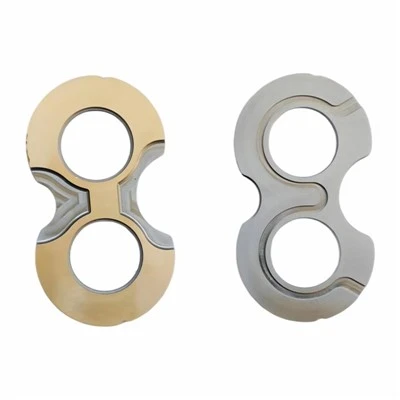
First off, let’s cut the jargon a little. I see a lot of suppliers throwing around numbers like they’re magic, and honestly? That’s how people get burned. Your basic thermal expansion coefficient (we usually shorten it to TEC, no need to say the whole thing every time) is just how much a material stretches or shrinks when its temperature changes—per degree, basically. For monometal stuff, like plain steel or copper, it’s pretty straightforward: one number that works across most use cases. But bimetal side plates? That’s a whole different animal, and that’s why I get so many questions about it.
Wait, let’s back up for a sec so we’re all on the same page. What even are bimetal side plates, anyway? From where I sit, working with these things daily, they’re made by bonding two different metal layers together permanently—usually something like steel (low expansion, let’s call it “side A”) and bronze or copper alloy (higher expansion, “side B”), sometimes stainless steel and nickel alloys, depending on the job. We don’t just glue them; we use diffusion bonding or high-pressure rolling, so they don’t separate even when temps swing hard. That dual-layer thing is why their TEC isn’t a single number. It’s a weighted average—based on how thick each metal layer is, and what each of their individual TECs are.
Let’s break that down with numbers most people get. Like, let’s say you’ve got a bimetal side plate that’s 50% 304 stainless steel (TEC of about 17.2 x 10^-6 per °C, for reference) and 50% brass (TEC around 19 x 10^-6 per °C). Its average TEC would be roughly 18.1 x 10^-6 per °C. But if we make it 70% stainless and only 30% brass? That drops to like 17.7 x 10^-6 per °C. The layer thickness is non-negotiable here—way more important than picking the two metals, honestly. If you mess up that ratio, the bimetal won’t do what it’s supposed to.
Now, here’s the thing: I can’t just give you one number and call it a day. Because bimetal side plates aren’t one-size-fits-all. The TEC depends entirely on the combination of metals we use, and that’s tailored to what our customer is using it for. Let’s run through the most common ones we make, just so you get a sense.
First, the go-to for most general manufacturing: our standard steel-brass bimetal side plates. Those are our bread and butter, right? Their TEC usually lands between 16 x 10^-6 and 19 x 10^-6 per °C. That range works great for things like conveyor systems, small machinery housings, or even parts for HVAC units—stuff where temps don’t swing super extreme, just consistent day-to-day shifts.
Then we have the ones for higher-stakes jobs: like side plates made with invar (that low-expansion nickel-iron alloy everyone uses for precision work) paired with stainless steel. Those are for environments where temps can jump 50+ degrees fast—like industrial furnaces, aerospace components, or even parts for lab equipment. Their TEC is way lower, usually between 6 x 10^-6 and 10 x 10^-6 per °C. Why? Because invar barely expands at all when it heats up, so it balances out the stainless. That’s the kind of thing that prevents warping, which is huge if your part has to line up exactly every time it cycles.
Wait, and don’t forget about the extreme ones for even crazier conditions. We’ve done bimetal side plates with copper and tungsten for things like heavy-duty automotive parts or power generation equipment. Their TEC is a bit higher, around 10 x 10^-6 to 15 x 10^-6 per °C, but that’s exactly what you need when you’re dealing with super high heat and constant pressure—they flex just enough without failing.
But here’s a myth I need to bust real quick: some guys online will tell you “bimetal TEC is fixed, no questions.” That’s garbage. Even for the same two metals, if the layer thickness is off by even 5%, the TEC shifts. And if you’re using the side plate for something that has a specific TEC requirement—like fitting with another part that expands at a exact rate—you can’t just pick a random bimetal. You have to customize it. That’s where we come in. A lot of new customers don’t realize that at first; they’ll ask for “standard” TEC, not knowing that their specific application needs a custom mix.
Let me give you a real example from last year, to make this concrete. A customer reached out to us needing side plates for a solar tracker system. They said their current side plates were warping every summer, when temps hit 120°F (that’s like 49°C) and dropped to 20°F (-7°C) in winter. Their old bimetal had a TEC that was too high, so it expanded too much in the heat and didn’t contract enough when it cooled, leading to misalignment and the whole tracker getting off. We worked with them to tweak the layer ratio: instead of their original 60/40 stainless-brass, we did 80/20 invar-stainless, brought the TEC down to ~8 x 10^-6 per °C, and fixed their warping problem completely. That’s the stuff that makes this job worth it, honestly—solving a problem that customers didn’t even know came down to TEC.
Now, if you’re shopping around for bimetal side plates, how do you make sure you’re getting the right TEC? First, figure out your operating environment. What’s the temp range your part will see? Is it close to room temp, or extreme high/low swings? Second, check what other parts your side plate will be paired with. If it’s going next to a monometal part that has a known TEC, you want your bimetal’s TEC to match as close as possible—otherwise, you get stress, which leads to cracks or separation.
And a quick warning: if a supplier gives you a single TEC number for all their bimetal side plates, run. That’s lazy, and it’s a sign they’re not customizing for your needs. We don’t do that here. For every order, we first ask for specs: operating temp, layer thickness you need (or can work with), what the side plate is used for, even if there’s a part it has to fit with. Then we run calculations on the TEC, test sample pieces to make sure it holds up, and only then send the final product. No guesswork, no cutting corners.
Wait, let’s talk about testing, because that’s the part people never see, but it’s critical. We don’t just calculate TEC on paper—we use thermal expansion analyzers to measure it on actual parts. We heat and cool test specimens slowly, track their dimensions, and get a precise number that’s within ±0.5 x 10^-6 per °C of what we calculate. That’s consistent enough for any industrial use case. If we didn’t test, we’d have parts that don’t perform as promised, and that’s a headache for everyone.
I know this stuff can feel super technical, especially if you’re not a materials engineer. But here’s the takeaway: bimetal side plates’ thermal expansion coefficient isn’t one number. It’s a custom value based on the metals we bond, their thickness ratio, and your specific application. The last thing we want is a customer getting a part that works for their neighbor’s project, but not theirs.
If you’re reading this and you’re in the market for bimetal side plates, don’t hesitate to reach out. We can walk you through what metals work best, what TEC range you’ll need based on your job, and send sample specs to test if you want. No pushy sales talk, no hidden fees, just straight answers about how our parts perform. We’ve worked with everything from small local machine shops to big aerospace companies, so we’ve seen just about every use case you can think of.
Just to recap, so you don’t have to re-read all this: TEC for bimetal side plates is a weighted average of the two metal layers’ individual TECs, dependent on thickness. Our standard ones are 16–19 x 10^-6 per °C, precision ones for extreme temps are 6–10 x 10^-6, and high-heat ones are 10–15 x 10^-6. Always specify your operating conditions when ordering to get the right TEC.
If you’ve got more questions—whether it’s about TEC, material combinations, lead times, anything—hit us up. We’re here to help you get the right part for your job, no matter how small or big.
Bimetal Strips & Sheets References
- ASTM International. Standard Test Method for Linear Thermal Expansion of Solid Materials With a Vitreous Silica Dilatometer. ASTM E228-17.
- NIST. Thermal Expansion of Metals and Alloys. National Institute of Standards and Technology, 2022.
- Assembly Engineering. “Bimetallic Materials: How Layer Thickness Affects Thermal Performance.” Assembly Engineering, 14 Mar. 2023.
Qingzhou Baiyun Anti-friction Products Co., Ltd.
With abundant experience, we are one of the most professional bimetal side plates manufacturers and suppliers in China. Please rest assured to wholesale customized bimetal side plates at competitive price from our factory. Welcome to contact us for quotation.
Address: Linglongshan North Road (south of the railway bridge), Economic Development Zone, Qingzhou City, Weifang City, Shandong Province
E-mail: byantifriction@gmail.com
WebSite: https://www.baiyunbimetal.com/
